I've seen pictures of Theo Katzman. He is not (in my personal opinion) a very photogenic man. But when he gets on stage, I can't take my eyes off of him. Here he is, on stage at the Ark, playing with his band Love Massive, and he draws us into the music. He's got the kind of good-natured stage presence that makes the crowd happy to stop half a minute into a tune because he started in a too-high key—we can just laugh about it, and get caught up again in the show. We can hear it all again without even mild complaint.
The music is full-bodied and—well—happy. The band balances out: Joe Dart grooving with his bass line, Mike Shea on the drums, and guest guitarist Tom Stoker completing the motion of the band. All of this fitting together, sounding like the music is meant to be this way, with Theo Katzman as the centerpiece.
They finished with the song 'Feel Love All The Time,' which starts off with the audience joining in on the chorus, and continues with lyrics that are everything I ask for. They work. They have meaning. They're effortless—and above that, they don't sound like they're being written for preschoolers with unending rhymes. In fact, they don't really sound like lyrics at all*:
Somebody called me a fag today
cause of the shoes I wear
They're the only pair I ever bought myself
They cost me a hundred bucks
and I was proud of it
cause I worked for that shit
but I didn't work that hard
It's all so easy—the way the band sounds like they do nothing besides jam together, the lyrics, the performance so laid-back but still full of energy. When the song is done and they leave the stage, the audience is up and applauding. We're wanting a last song, something to hold onto, and a little afraid the band wouldn't have any tunes left for an encore—but here they come, with that stage love, making jokes as they set up about being asked to play Mustang Sally at their last gig. And so we plunge in again, with a furious guitar solo from Stoker; Joe Dart loose-jointed and bobble-headed in all the right ways; Theo Katzman singing and playing guitar while moving in a compact, wild, inviting fashion.
I don't know how he does it—makes me feel so welcome, makes me feel like everyone in the room is welcome, while at the same time making me forget that there is anyone else on the stage. Intellectually, I know he's there with Love Massive, but I can't drag my eyes away from him long enough to watch Joe Dart play the bass, and I love watching that man play bass. This sounds bad, in an obsessive way, but I promise, it's only when I see him onstage.
*I once posted this as my facebook status, and people were asking me if I was traumatized by the experience, and what kind of shoes they were. Not a single person figured out that they were lyrics.
Sunday, March 20, 2011

Saturday, March 12, 2011
Pt. 1: Let's Hear That Again...
When I heard Hannah Winkler was opening for Theo Katzman & Love Massive at the Ark, I made sure (with a little begging and cajoling) that I would be there. Hannah is someone I've been running into at various shows around Ann Arbor for a while. The last time I saw her on stage, though, was as a supporting musician for Theo Katzman when they opened this year's Ann Arbor Folk Festival. She was bang-up then, but I wanted to see what she was up to on her own—and of course another chance to see Theo Katzman & Love Massive made the package perfect.
The line to get in the building at ten minutes to 8 meandered down the sidewalk. People in line were questioning whether we would get in, quoting a local myth that whoever opens the Folk Fest will sell out the Ark for their next performance. We all squeezed in, but the stage remained empty until more or less everyone found a satisfactory place to sit—I was tucked up in a corner with a good view of center stage and a couple minutes later, of Hannah and her guitar.
She's got a voice that shifted from sweet and nostalgic with an occasional wavering vibrato, to cutting and focused. Her voice sounded most comfortable when paired with her guitar, but the guitar sound was thinned out by the drummer and bassist backing her up. Things heated up when she switched from guitar to the heavier sound of the keyboard for a humorous tune based on the idea, 'I wish I were the kind of person who has their shit together'. (I wish I were that kind of person too...) The performance was rounded out when she was joined by Theo Katzman, providing accompaniment with some rather abrupt bottleneck guitar.
When she introduced the band, Hannah told the crowd this was the second time they'd played a show as a group. With Rob on drums and Jordan on bass, Hannah's group is still coming together. They've got a couple rough edges, but they're still playing some tunes that I sure would like to hear again.
Wednesday, August 18, 2010
Things That Matter
This is a confession: I know Mike Ball, of a local trio going by the tag Dr. Mike and the Sea Monkeys. I know Mike pretty darn well. I've watched fireworks from his back deck, cruised the lake in his boat, and I blush every time he tells people how fantastic I am. I've heard nearly all the songs he'll be playing tonight with the Sea Monkeys, Scott Clauser and Bert Franco.
He's the only person who has ever written a song for me. Well, sortof for me. Granted, it's called the Slushnugget Blues, and it's not about me at all—it's about the things you find when the snow melts. Like boxer shorts and lipsticked phone numbers. Still—I have my own song, and Mike promised to play it for me tonight.
So I might be a little bit biased when I say that Mike puts on a good gig. Here’s the trick, though—what I’m writing isn't about Dr. Mike and the Sea Monkeys being extraordinary musicians, or impossibly funny. It's not about Mike's column, 'What I've Learned So Far,' which inspired a number of his tunes.
It's about kids.
Incarcerated kids, actually, and a program called Lost Voices. Lost Voices takes roots music to incarcerated kids—kids who have done some truly horrendous things—and by having them examine what's on their minds and putting it to music—hey presto! we’ve got personal growth and healing. It’s not as simple as that, but changes in a body’s life and direction never are.
Mike’s telling the audience about Lost Voices as an introduction to a song that was written by the kids he’s worked with, a blues tune that turns his voice growly and broad. It’s a change from the light John Prine tune he started with—something about peaches and level-headed dancers. He’s moved into a unified vision of a what-happens-next world, where kids that have spent time lined up in yellow shirts are stepping out and thinking,
In and out of locked doors
Same old song and dance
This time’s gotta be different;
Ain’t gonna be another chance.
It’s a story—the story, maybe—that a lot of the incarcerated kids live. It’s scruffy and painful—it’s the story that should bring you to the Concert for Lost Voices next week on August 27th, because before the ending of a story can change, there has to be someone that sees another way out.
It’s a point Mike returns to throughout his concert—but not where he stays. With Bert Franco standing solidly on the bass line, and Scott Clauser on mandolin or second guitar, Mike works his way through classic tunes like ‘The Weight’ from The Band, and ‘Sweet Home Chicago’ from Muddy Waters. He throws in tunes he’s written, about still having most of his hair, or about dogs and husbands being there to stay. The favorite—or the most offensive—is a tune he wrote about getting a colonoscopy (“It’s a polyp, not a trollop!”). His voice switches between the gravely tone he took with the first Lost Voices tune and a clown-y, higher-hanging voice that twangs.
I’m laughing and clapping and mouthing along with the words (remember, I’ve heard these all before). That is, until Mike is saying, “Here’s the last tune, thanks for coming out tonight, I hope I’ll see you at the Concert for Lost Voices next Friday,” and he hasn’t played Slushnugget Blues for me. People are folding up their chairs and leaving, or shoving their pontoon boats away from the shoreline, and I’m still waiting for that song. I’m giving Mike a look that makes him reach for his guitar and sing me a song. Everything around us is being packed up, but Bert picks up a second guitar to slide out some chords behind Mike—we’re standing on our own square footage of music, and it’s being played just for me.
Monday, August 9, 2010
Rooted Deeply
I’m up in Whitmore Lake tonight, catching a performance of Cats and the Fiddler at the Northfield Township Area Library. It’s an always favorite place, spiced up tonight by a spot of bluegrass music on the lawn. Cats and the Fiddler is an unexpected group—a trio of fifteen-year old musicians.
Fifteen-year old musicians playing bluegrass—bluegrass!—and playing it with skill. They’re rooted deeply into an older America, evoked by their instrumentals and traditional folk tunes. Even their own tunes, where a man might spend his life shoveling coal, or Jezebel is sinning again, have a feeling of being older than the years these musicians can lay claim to.
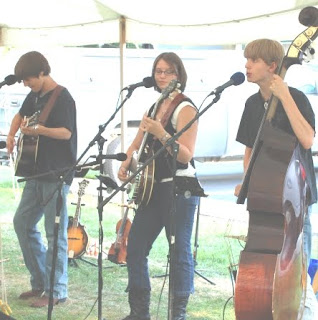
Photo courtesy of Mike Ball.
I'm watching Carmen Gibes. Her fingers are flicking out over the instantly recognizable sound of the banjo—pausing for a moment to let Shaun Richardson's guitar rest up against the sound of his twin brother James’s upright bass—the upright bass pulling the music along through the basic, constant patterns of chord changes—then her fingers are moving again, and her voice is rising over the sound of the instruments, joined in close harmony by both boys. They’re playing tunes with the tricky tumbling of the mandolin instead of a guitar, guitar instead of banjo, fiddle instead of mandolin, each instrument counterbalanced against the other. The licks pass quickly, but with space enough for a finger-flying solo, a change in color and tone and texture, a patch of walking bass from James instead of simple chord foundations.
And then—besides the mesmerizing, busy fingers plucking music from too many strings—James is singing lead, his voice loose and young against the crisp twang of the mandolin, Shaun and Carmen vining their voices around his. The tune ends—pause for a moment—here is Shaun with his fiddle. He’s got a clear toe-tapping sound for a train-whistle tune—and then again, faster!
We slow down for the story of the band told through the tune ‘Road to Nashville.’ It’s instantly relatable, sweet and singable (if only I knew the words!). They’ve told us their story between tunes, how they began playing music, making the switch to bluegrass at age six…how they’ve been a band ever since (the math on that puts Cats and the Fiddler at nine years old). Here, they’ve put the words to the tune, invited us to step closer and watch them grow.
They’ve got a few last tunes for us, including one of my favorite traditional folk-tunes, ‘The Fox’ (otherwise known as ‘The Fox Went Out On A Chilly Night’) and a gospel tune or two. Shaun is whispering to James and Carmen, and I’m surprised when they finish up with an instrumental—but with improvisation. The high, bright sounds of the mandolin spill from Shaun’s hands—Carmen goes at it with her three-finger picking style on the banjo while he switches out to guitar—James gives us a straightforward bass solo—and then suddenly, unexpectedly, the show is over. The air is bluegrass-less. I am holding on to my inner echoes, and my feet are taking me home.
This performance took place August 6, 2010.
Fifteen-year old musicians playing bluegrass—bluegrass!—and playing it with skill. They’re rooted deeply into an older America, evoked by their instrumentals and traditional folk tunes. Even their own tunes, where a man might spend his life shoveling coal, or Jezebel is sinning again, have a feeling of being older than the years these musicians can lay claim to.

Photo courtesy of Mike Ball.
I'm watching Carmen Gibes. Her fingers are flicking out over the instantly recognizable sound of the banjo—pausing for a moment to let Shaun Richardson's guitar rest up against the sound of his twin brother James’s upright bass—the upright bass pulling the music along through the basic, constant patterns of chord changes—then her fingers are moving again, and her voice is rising over the sound of the instruments, joined in close harmony by both boys. They’re playing tunes with the tricky tumbling of the mandolin instead of a guitar, guitar instead of banjo, fiddle instead of mandolin, each instrument counterbalanced against the other. The licks pass quickly, but with space enough for a finger-flying solo, a change in color and tone and texture, a patch of walking bass from James instead of simple chord foundations.
And then—besides the mesmerizing, busy fingers plucking music from too many strings—James is singing lead, his voice loose and young against the crisp twang of the mandolin, Shaun and Carmen vining their voices around his. The tune ends—pause for a moment—here is Shaun with his fiddle. He’s got a clear toe-tapping sound for a train-whistle tune—and then again, faster!
We slow down for the story of the band told through the tune ‘Road to Nashville.’ It’s instantly relatable, sweet and singable (if only I knew the words!). They’ve told us their story between tunes, how they began playing music, making the switch to bluegrass at age six…how they’ve been a band ever since (the math on that puts Cats and the Fiddler at nine years old). Here, they’ve put the words to the tune, invited us to step closer and watch them grow.
They’ve got a few last tunes for us, including one of my favorite traditional folk-tunes, ‘The Fox’ (otherwise known as ‘The Fox Went Out On A Chilly Night’) and a gospel tune or two. Shaun is whispering to James and Carmen, and I’m surprised when they finish up with an instrumental—but with improvisation. The high, bright sounds of the mandolin spill from Shaun’s hands—Carmen goes at it with her three-finger picking style on the banjo while he switches out to guitar—James gives us a straightforward bass solo—and then suddenly, unexpectedly, the show is over. The air is bluegrass-less. I am holding on to my inner echoes, and my feet are taking me home.
This performance took place August 6, 2010.
Monday, July 19, 2010
Part II: Pretty Boys & Noise
The Macpodz are setting up on stage, empty minutes after Groove Spoon's set. I am remembering walking through Top of the Park a few years ago during a performance of theirs—but their music escapes me. My memory of that night is taken over by My Dear Disco and a view of those multi-colored lights thrown against Rackham Hall as seen from the top of a parking structure. There’s another dim-lit memory, too, of band-member Ross Huff playing some very sweet trumpet for Charlene Kaye at The Ark. And of course, the far more recent memory of bassist Brennan Andes pulling strings next to Groove Spoon’s Joe Dart. So here’s tonight, only I’m going to tell you this story in flashes.
There’s something here—I’m searching for the underlying beat, bass line, rhythm only to realize that my feet have caught it before the rest of me. There’s my friend Adam on one side and his twenty-month old son on the other (the ultimate excuse to dance, no matter what the music, is a small child) and we are in a whirling, hand-holding circle—and somehow there has to be less noise and more rhythm closer to the ground because our feet are lifting and falling, we’re speeding along without stumbling—
—I’m watching the keyboard player, a neatly-kept boy by the name of Jesse Clayton, watching his fingers following the patterns of broken chords, over and over and over. He draws it on, two hands and so many keyboards, changing the chord but still in the same outline until I lose the sense of any chords. There’s repeated noise but I can’t hear what it means to the music, where it fits against the drums and the bass and the lonely overcome trumpet. All of these instruments are up against each other and covering up the sound—I can’t tell if these boys are forgetting what is important or if they are just too caught up in the space of the stage, in their own individual places, to find a balance—
—and then—there’s a bit of quiet. For the flute—which, by the way, would be way easier to hear through a bunch of noise than a trumpet due to its higher frequency—the flute in the hands of Nick Ayers. He’s beat-boxing and fluting at the same time, a neat little trick that brings the rest of the band down. It’s a touch of relaxation, a spot away from the tense, obsessive rocking out.
The end of the night—there is an end of the night, where I am exhausted and pulling my arms against the dark skies and bright lights of Top of the Park—comes with a tired-sounding Ross Huff and a bassist promising to jam until they get kicked off the stage. Andes is still wildly energetic, playing his bass with half a sneer (he must practice that too, I am thinking) and pulling the Macpodz into a messy, extended jam session. My boundaries are breaking apart; I leave. The pretty boys are staying on stage (despite the long hair and attempts at grunge, yes, they are a bunch of pretty pretty boys). I’m staggering away and I can hear Andes’ voice going flat as he sings the only recognizable lyrics of the performance: “Up on High Street…”
This performance took place July 9th at Top of the Park.
Thursday, July 15, 2010
Part I: Did I Mention We're In Space?
Groove Spoon.
Say it out loud.
Say it again.
Grooooove Spooooon.
Listen to that lovely assonance, the way each word centers around the same vowel sound. The way it suggests something smooth and funky. Something fruity-flavored and fun to dance to. Something a little—I shouldn’t say it—groovy.
There’s no help for it. That’s the proper word. Groove Spoon is a funk band finding something a little behind the times, a little chunky and outdated, and making it part of today. Not ten feet from me is a couple wearing matching shirts, colored by hand to say ‘The Bump Is Back’. They are touching hip to hip every other beat, changing angles, never out of step, thinking back to a dance and a time before me. The rest of us—too young or uncoordinated to remember a dance with identifiable 'moves'—we shake our hips and shimmy and swing our arms about. We get lost in a transition between the past and present.
We're listening for the voice of Antwaun Stanley, and the something about it that says, 'This is the music and this is the love. It's yours and mine together.' It’s a side effect of Stanley’s on-stage magnetism and charm, bolstered by back-up singers Emily Berman and Hannah Winkler. They discreetly pull his presence away from the edge of narcissism while adding their own impressive style. Behind them in a purple Lakers jersey, drummer Jack Stratton holds my attention with the wacky, seemingly-panicked faces and strange extra vocals while simultaneously playing the drums without loosing his rhythm or overwhelming the other parts of the band.
In this ten-piece band, there’s also a little section standing off to the side at the front. There’s a sax, a trombone, and a trumpet (borrowed, I hear, for this performance) collectively known as The Corporate Brass. They’re in shirt and tie, conspicuously straight-laced compared to the rest of the band. They’re making good sounds, adding that brassy element that brings an element of brightness to the group. The sax player is making his mark on the musical landscape—but despite their nice tones, the two brass players are taking a back-shelf approach. They’re not loosening themselves from the black and white of the page to make themselves part of the performance. But, you ask, isn’t that why they’re The Corporate Brass? Maybe. I just want them to be more like the bass player, Joe Dart.
He’s cached in with the rest of the rhythm section, the meaty, bony structure of the band, hidden under the skin. He’s not making himself obvious or moving in flashy ways—he’s just playing his bass with a nonchalant, good-natured enjoyment. That, and playing a bass-line I can’t stop listening to, even with its often-repetitive nature. It might just be funk, or talent, or a combination thereof; but he’s holding the band to the ground with the ever-present, underlying swagger of his bass. His moment to show us what he can comes when the bass player from the Macpodz came up for a bass-off. It’s a moment replete with high-energy bass licks that rarely get have a chance to get aired—and then he’s right back to jamming in the basement of the funk house that is Groove Spoon. (Did I really just write that sentence? Yes I did.)
So say it: Groove Spoon. They have flash and solidity; they've got a bass line I could listen to over and over. They're a part of today and a time when people thought the song 'September' by Earth, Wind and Fire was more than just a bad pep band cover. It's a band that I enjoyed, and as their t-shirt states, “would recommend listening to in most situations.”
This performance took place July 9th.
Monday, July 12, 2010
We Live In The Same Town...
The crowd at Top of the Park tonight is small, straggling in from places that are safely roofed and away from the rain. There are college students emerging from the beer tent, and some stodgier types wiping off the chairs to sit down. Erin Zindle has maracas in her hands and her voice is pulling people from the damp folding chairs to the open space in front of the stage. The Ragbirds are a band with a lot of rhythm, and 'Jump In The Line' (more familiarly, perhaps, as 'Shake Sonora' from the end of the movie Beetlejuice) is a tune that makes a body want to dance. The two sets of drums—one very African looking, the other a traditional drum-set—are full of propulsion; with the bass, they produce the rhythmic pulse that is the underlying structure of the tune. Around me there are loose limbs, arms and legs and hips moving in response.
There are other songs, other moments in this performance where I am unable to escape the rhythm and the dusky sound of Erin Zindle’s voice. She is the catalyst here, a presence full of verve and joy, lighting up the unadorned but serviceable lyrics. Singing with a violin under her chin or a mandolin in her hands, her voice is bouyant, balanced, and touched with fluff. A butterscotch smile up on stage, she is supported vocally by the harmonies of guitar player T.J. Zindle and bassist Dan Hildebrandt. She's the recognizable face of the Ragbirds, with a seemingly endless supply of energy and enthusiasm spilling into her performances, which is especially noticeable when it's live.
There's an explanation for the Tarantella, offered up by Erin Zindle before the song is begun. It's a folk dance originating in Italy, meant to rid oneself from a spider's poison by a fast and wild dance. The Ragbirds, drawing on one of their many cultural influences from around the world, created their own version that begins with a draggingly slow introduction—but I can feel the moment approaching when the tempo will pick up. Erin caught the attention of the listeners with her short explanation, and they are swaying in close attention, waiting for that faster tempo. When it comes, the whirl of dancers starts to move. The tempo speeds up, and control of my body is given over to the experience of the music coming frantically off the stage.
At Top of the Park, the Ragbirds are in their home territory. Despite an apparent propensity to travel, Ann Arbor is their base. With Ypsilanti only a few steps to the east, it’s only natural to hear their ‘Ypsilanti Song’ at this performance. It’s catchy, with repeating rhythms and words; but what makes it near and dear to me is the silly reason that Ypsilanti is my current hometown. It’s not as charming if I’m hearing it via video or performance—the human element is missing, and the beat doesn’t fall as insistently against my collarbones—but who doesn’t want to be sung a song about their hometown by a cutely-pigtailed woman with that blend of rhythm behind her?
This performance was July 8th, 2010.
Subscribe to:
Posts (Atom)